At least 4,000 were lynched – a repost … reminder


A group documenting lynchings is trying to erect markers at the sites, but expects local opposition.

Nearly 4,000 African Americans were victims of “racial terror lynchings” in the South between 1877 and 1950, according to a new report by the Equal Justice Initiative.

The report, released today, is the result of some five years of research by the organization. It has found that racial terror lynching was much more prevalent than previously reported. The researchers documented several hundred more lynchings than had been identified in the past. They did so by reviewing local newspapers, historical archives and court records. They also conducted interviews with local historians, and the families and descendants of the victims.

In all, EJI documented 3,959 lynchings of black people in twelve Southern states, which is at least 700 more lynchings in these states than previously reported. More than half of the lynching victims were killed under accusation of committing murder or rape against white victims. The EJI says that racial hostility fed suspicion that the perpetrators of the crimes were black and the accusations were seldom scrutinized. “Of the hundreds of black people lynched under accusation of rape and murder, nearly all were killed without being legally convicted,” says the report.

Some states and regions were particularly terrifying for African Americans, with dramatically higher rates of lynchings compared to the rest of the South. These areas included Florida, Mississippi, Arkansas and Louisiana. Counties that were particularly terrifying were Hernando, Taylor, Lafayette, and Citrus counties in Florida; Early and Oconee counties in Georgia; Fulton County, Kentucky; and Moore County, Tennessee, which had the highest rates of lynchings. Phillips County, Arkansas, and Lafourche and Tensas parishes in Louisiana were regions of mass killings of African Americans that make them historically notorious. Georgia and Mississippi had the highest number of lynchings of all the Southern states.

In conversations with survivors of those that had been lynched, EJI found that lynching played an integral role in the migration of millions of African Americans away from Southern states.

EJI also found that there was an astonishing lack of effort to acknowledge, discuss or address lynching in Southern states and communities. According to the report, many of these communities tried to veil this violent past by erecting monuments memorializing the Confederacy and the Civil War instead, while hiding the violence and terror used against African Americans.

The report says that there are currently few memorials that address the legacy of lynching, and that most communities do not actively  recognize how their race relations were shaped by terror lynching.

Bryan Stevenson of EJI told the New York Times that his group wants to force people to reckon with the country’s violent and racist past by erecting the memorials. He said the EJI hopes to select some of the lynching sites and erect markers there. This will involve a significant amount of fundraising by the non-profit group. EJI is also bracing for controversies and objections as it tries to erect these markers.

“Lynching and the terror era shaped the geography, politics, economics and social characteristics of being black in America during the 20th century,” said Stevenson.

The report by EJI is part of a larger project that also involves the recognition of slave markets in the South and the erection of markers on those sites, particularly in Montgomery, AL. Stevenson said that  regional and state governments have not been receptive to such markers although there are plenty of Civil War memorials in Montgomery, as well as some Civil Rights movement markers.

Demand that President Judge Shiela Woods-Skipper end the unjust use of detainers in Philadelphia immediately.


Meek Mill is free but thousands of other people still sit in Philadelphia jails being held on detainers, with no court date or opportunity to post bail. 

Demand President Judge Shiela Woods-Skipper end the use of detainers in Philadelphia. 

TAKE ACTION

–Meek Mill is finally free!

The Pennsylvania Supreme Court ordered his immediate release yesterday–this is huge, but there are still thousands of other Black people that should be freed with him.1 Let’s get all our people out.

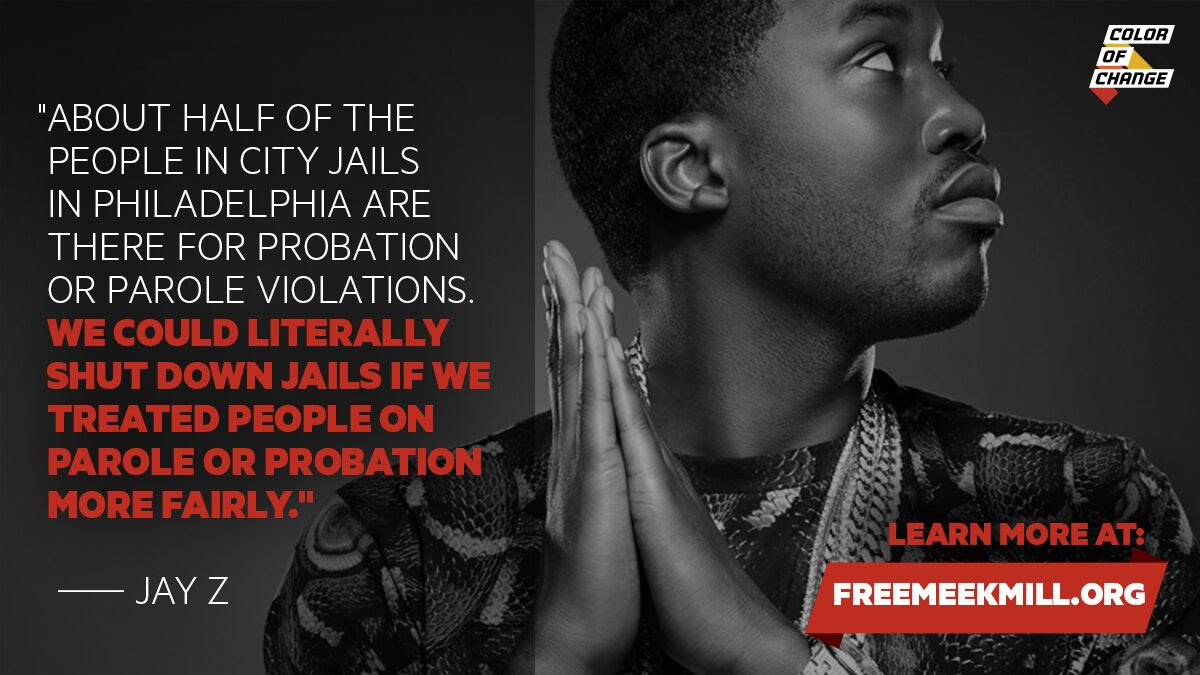
Meek’s case has been so important, not only because it calls out the injustice that he’s experiencing within the criminal justice system, but it has allowed us to shine a light on the unjust experiences of so many others. Today there are thousands of other Philadelphians who are sitting in jail on probation detainers, waiting for their day in court, and not even offered the option to post bail for their release. In Philly, over 50 percent of people in city jails are being held without a hearing on probation detainers.2 

Sign the petition: The Philadelphia Court of Commons Pleas must stop the use of detainers to hold people in jail before they even get a chance to see a judge.

Detainers allow probation officers to jail people due to alleged probation or parole violations, without a judge even hearing the case. People who are in jail on detainers have no option of pretrial release. This means if you’re on probation or parole and miss a meeting with your probation or parole officer, or for something as minor as a traffic violation, your probation or parole office could put you in jail on a detainer. You could spend months in jail, waiting for a backed up system to process the papers necessary to schedule your court date.The use of detainers is illegal and Judge Shiela Woods-Skipper has the power to stop this practice.3

This is not what justice looks like. The use of detainers keeps people in jail for months at a time without even giving them a day in court.

Detainers are used as a way to unjustly keep our people locked up–join us in demanding that Philadelphia immediately end the use of detainers.

Philadelphia already has the second highest rate of incarceration in the U.S. and half of the people sitting in jail are there because of probation or parole violations. Detainers are being used to keep people in jail with absolutely no access to justice and often people wait in jail for their court date for longer than what their sentence could potentially be. However, there is hope–by simply ending the use of detainers in Philadelphia the jail population could significantly decrease. Philadelphia’s criminal justice system has been feeling our pressure in demanding for Meek Mill to be free, and today they listened to us and Meek will be able to go home. We must keep the pressure on until all our people are home–we were able to free Meek and we can free so many more!

Meek Mill has been on probation since he was 19 years old–his entire adult life. Even after spending time in prison as a teenager, when he was released he was placed on probation. Meek is now 30 years old and has been sentenced to two to four years in prison by a biased judge seeking to punish him for insignificant violations of his probation–one was even as petty as riding a dirt bike in New York City to film a scene for a music video.4

Meek Mill’s case has generated a lot of conversation about the trap of the probation and parole system–and how it keeps so many Black people living under the supervision of the criminal justice system for years. Jay-Z stopped one of his concerts to talk about the injustice Meek is experiencing, he then wrote a New York Times op-ed about this, Colin Kapernick has spoken out for Meek, and his case is even getting covered on daytime television shows like the Wendy Williams show.4 What’s even better than getting so much public attention about Meek’s case is that the conversation has moved past just Meek and is inclusive of broader issues within the criminal justice system, like the unjust use of detainers illegally trapping so many in jail.

Demand that President Judge Shiela Woods-Skipper end the unjust use of detainers in Philadelphia immediately.

Until justice is real,

–Clarise, Rashad, Scott,  Arisha, Kristen, Anay, Marena, and the rest of the Color Of Change team

References:

1.“Meek Mill to be released from Prison,” CBS News, 24 April 2018

2. “How minor probation violations can lead to major jail time,” The Atlantic, 9 June 2017

3. “Top public defender says ‘automatic detainers’ are illegal, swelling Philly jail population,” whyy.org, 27 March 2018

4. “Jay-Z: The criminal justice system stalks Black people like Meek Mill,” The New York Times, 17 November 2017

In 48 hours the EU could TOTALLY BAN bee-killing


Sign now

In 48 hours the EU could TOTALLY BAN bee-killing pesticides! France, the UK, Germany and 9 other countries are in favour, but we need to get four more on board to win the vote. This is down to the wire. Every signature counts — sign now with one click and share this everywhere.

SIGN NOW

Dear friends,

Right now, across the world billions of bees are dying. But, in 48 hours the EU could TOTALLY BAN toxic bee-killing pesticides!

Top scientists and farmers’ unions are calling for a ban, the European public massively supports it, and France, the UK, Germany and 9 other countries are in favour. But we need four more countries on board to win the vote on Friday. If Europe moves — we can get the whole world to follow.

This is down to the wire and every signature counts — sign now with one click and share this everywhere today:

Click to ban the bee-killers!

To EU member states, and all world leaders and agriculture ministers:

“We call on you to immediately ban the use of neonicotinoid pesticides. The catastrophic demise of bee colonies could put our whole food chain in danger. If you act urgently with precaution now, we could save bees from extinction.”

Click to ban the bee-killers!

The US and Europe are seeing bees die out at a terrifying rate. And because they pollinate our crops, our whole food chain is under threat!

But big chemical companies that sell pesticides are lobbying the EU to delay.  So Avaazers across Europe are frantically calling their Ministers, running ads, and building the pressure.

Now, we need to make this the biggest public petition ever for the bees. Join now with one click and tell everyone:

Click to ban the bee-killers!

The Avaaz community has led the charge to ban neonicotinoids, for years. Now we’re days away from getting this poison banned for good in Europe — let’s build a swarm of hope for our bees.

With hope,
Alice, Antonia, Lisa, Nick, and the whole Avaaz team

More Information:

Neonicotinoids: risks to bees confirmed (EFSA)
https://www.efsa.europa.eu/en/press/news/180228

Pressure mounts on Commission to put neonics ban to a vote (Euractiv)
https://www.euractiv.com/section/agriculture-food/news/pressure-mounts-on-commission-to-put-neonics-ban-to-a-vote/

The bitter battle over the world’s most popular insecticides (Nature)
https://www.nature.com/news/the-bitter-battle-over-the-world-s-most-popular-insecticides-1.22972