
Monthly Archives: April 2018

the fifth …it’s horrible

Demand that President Judge Shiela Woods-Skipper end the unjust use of detainers in Philadelphia immediately.
|
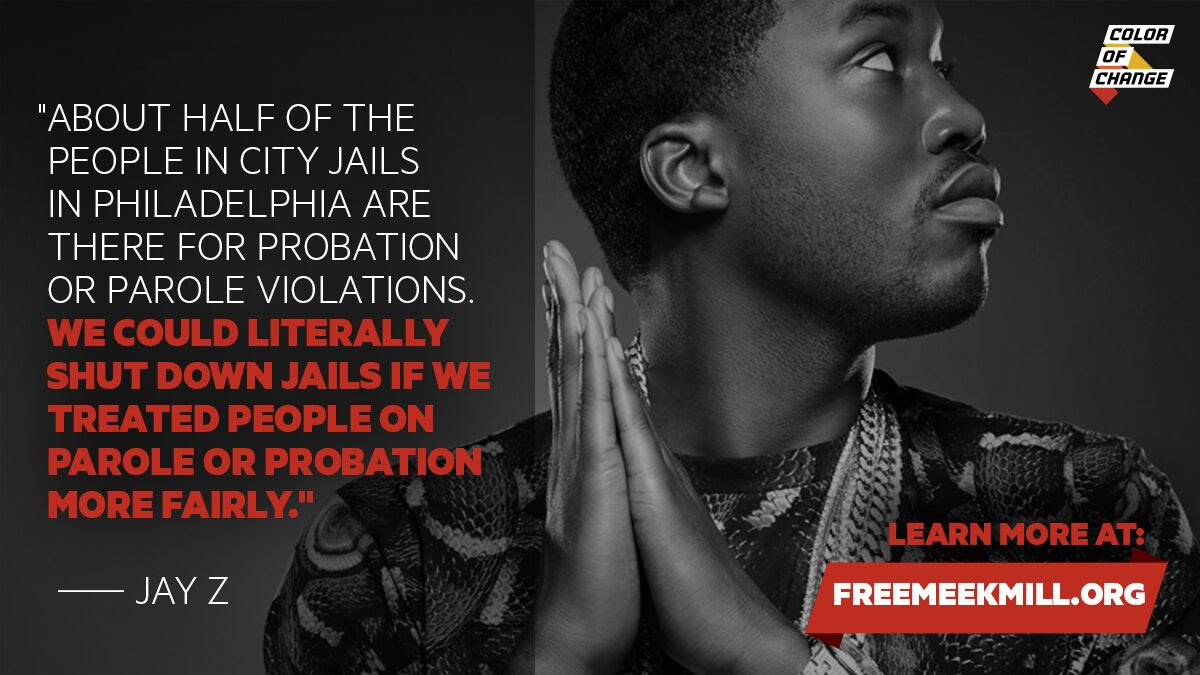
–Meek Mill is finally free!
The Pennsylvania Supreme Court ordered his immediate release yesterday–this is huge, but there are still thousands of other Black people that should be freed with him.1 Let’s get all our people out.
Meek’s case has been so important, not only because it calls out the injustice that he’s experiencing within the criminal justice system, but it has allowed us to shine a light on the unjust experiences of so many others. Today there are thousands of other Philadelphians who are sitting in jail on probation detainers, waiting for their day in court, and not even offered the option to post bail for their release. In Philly, over 50 percent of people in city jails are being held without a hearing on probation detainers.2
Detainers allow probation officers to jail people due to alleged probation or parole violations, without a judge even hearing the case. People who are in jail on detainers have no option of pretrial release. This means if you’re on probation or parole and miss a meeting with your probation or parole officer, or for something as minor as a traffic violation, your probation or parole office could put you in jail on a detainer. You could spend months in jail, waiting for a backed up system to process the papers necessary to schedule your court date.2 The use of detainers is illegal and Judge Shiela Woods-Skipper has the power to stop this practice.3
This is not what justice looks like. The use of detainers keeps people in jail for months at a time without even giving them a day in court.
Philadelphia already has the second highest rate of incarceration in the U.S. and half of the people sitting in jail are there because of probation or parole violations. Detainers are being used to keep people in jail with absolutely no access to justice and often people wait in jail for their court date for longer than what their sentence could potentially be. However, there is hope–by simply ending the use of detainers in Philadelphia the jail population could significantly decrease. Philadelphia’s criminal justice system has been feeling our pressure in demanding for Meek Mill to be free, and today they listened to us and Meek will be able to go home. We must keep the pressure on until all our people are home–we were able to free Meek and we can free so many more!
Meek Mill has been on probation since he was 19 years old–his entire adult life. Even after spending time in prison as a teenager, when he was released he was placed on probation. Meek is now 30 years old and has been sentenced to two to four years in prison by a biased judge seeking to punish him for insignificant violations of his probation–one was even as petty as riding a dirt bike in New York City to film a scene for a music video.4
Meek Mill’s case has generated a lot of conversation about the trap of the probation and parole system–and how it keeps so many Black people living under the supervision of the criminal justice system for years. Jay-Z stopped one of his concerts to talk about the injustice Meek is experiencing, he then wrote a New York Times op-ed about this, Colin Kapernick has spoken out for Meek, and his case is even getting covered on daytime television shows like the Wendy Williams show.4 What’s even better than getting so much public attention about Meek’s case is that the conversation has moved past just Meek and is inclusive of broader issues within the criminal justice system, like the unjust use of detainers illegally trapping so many in jail.
Until justice is real,
–Clarise, Rashad, Scott, Arisha, Kristen, Anay, Marena, and the rest of the Color Of Change team
References:
1.“Meek Mill to be released from Prison,” CBS News, 24 April 2018
2. “How minor probation violations can lead to major jail time,” The Atlantic, 9 June 2017
3. “Top public defender says ‘automatic detainers’ are illegal, swelling Philly jail population,” whyy.org, 27 March 2018
4. “Jay-Z: The criminal justice system stalks Black people like Meek Mill,” The New York Times, 17 November 2017
Share this:

In 48 hours the EU could TOTALLY BAN bee-killing

|


Share this:

BossFeed Briefing from Working Washington
Last Monday Domino’s announced they’re now delivering to outdoor locations across the U.S., including beaches, parks, and other landmarks. Last Tuesday, hundreds of taxi and flat-rate drivers rallied at Sea-Tac in opposition to a plan that would force them to pay $9,000 to keep working at the airport. Last Friday was 4/20, on which day the AP released a report showing the six US largest banks saved $3.6 billion last quarter due to the recent federal corporate tax cuts. And this Friday is the 24th anniversary of the election of Nelson Mandela as president of South Africa.
Feed the beast

Three things to know this week:
 Amazon warehouse workers in the UK are so closely monitored and so intensely pressured on their “efficiency”that they often don’t have time to use the bathroom when they need to. Amazon’s recommendation for a portable pee bottle sells for $13.28 on their site.
 Thousands of people who work in the food industry have to turn to food stamps in order to make ends meet. New Food Economy found that Taco Bell, Wendy’s, Pizza Hut, Burger King, Subway, McDonald’s, Starbucks, and Walmart are all among the top 50 employers of people using food stamps in Washington state.
 The Washington Retail Association, the state’s lobby group for big retail chains, reports that Washington state leads the nation in income growth, and that retail trade earnings increased 15.3% here, vs. 2.9% nationally. When the same group opposed raising the minimum wage in 2016, they argued that that it would be a “costly shock wave” that would result in “jeopardizing job retention and growth.”
Two things to ask:
 Think they’ll follow up? Four years ago Tuesday, the owner of Eastern Cafe told Q13 TV that he’d have to “shut his doors immediately” if $15 passed. Today wages are up, demand is up, and not only does the cafe remains in business — but the owner has opened several new locations.
 Will the country listen? Seattle Domestic Workers Alliance leader Etelbina Hauser appeared on 20/20 this weekend. Etelbina and several other women shared powerful stories about their experiences of sexual harassment and abuse on the job — and what can be done to make every workplace safe for every person.
And one thing that’s worth a closer look:
 Seahawks cheerleaders are a heavily promoted part of the football experience, but they are paid minimum wage, expected to clean their own uniforms, aren’t allowed control of their own social media accounts, and can be sent home any given day for weight gain. Members of the Sea Gals are also not allowed to “fraternize” with other Seahawks employees, which might not be an entirely absurd workplace policy except that the burden of enforcing the rule falls entirely on them — players can contact them without repercussions, they’re just not allowed to respond… under penalty of termination. If you’re a cheerleader, you can also be fired for any inappropriate comments “by you or about you” on social media. But perhaps most remarkable in this whole thing is the proffered explanation that perhaps pay is low because there’s a lot of competition for the jobs… considering that there’s sure a lot of competition to be a professional football player too, and yet that pay rate is fairly high.
workingwa.org


You must be logged in to post a comment.