

Monthly Archives: April 2021

Good Friday ~
Good Friday occurs two days before Easter Sunday in the United States. It is the day when Christians commemorate Jesus Christ’s crucifixion, which plays an important part in the Christian faith. It is not a federal holiday in the United States, although it is a state holiday in some states.
What Do People Do?
Some Christians may attend special church services or prayer vigils. Good Friday is a day of mourning and quiet prayer for many Christians. The candles are often extinguished and statues, paintings and crosses may be draped in black, purple or gray cloth. Some Catholics treat Good Friday as a day of fasting, while others observe a partial fast involving the exclusion of meat.
Some homes keep a quiet atmosphere, with little or no outside activities and limited television, radio, and computer use, in observing Good Friday. Others choose to play music such as JS Bach’s St. Matthew’s Passion. Some people bake hot cross buns, a traditional Good Friday sweet.
Good Friday is another day at work for many Americans, as it is not a national holiday. Some people may choose to take a day off work and have a long “Spring Break” weekend. In some states, employees are given a day off on Good Friday.
Public Life
Good Friday is not an official holiday in the United States. Regular services will continue according the schedule in some areas, including Toledo, Ohio, where the city’s refuse will be collected during its regular schedule. However, financial markets, as well as many businesses, public schools and universities/colleges are closed on Good Friday.
Good Friday is a state holiday in some states such as Hawaii, where city and state offices are closed and some forms of public transport (eg. buses) run on the state holiday schedule. In some areas, such as Perry County in Tennessee, Good Friday is a school holiday. Good Friday is a holiday designated by the governor as a day of fasting and prayer in Connecticut.
In accordance with state law, Indiana state employees are given a day off on Good Friday, a religious holiday. In 1999, in the case of Bridenbaugh v O’Bannon, an Indiana state employee sued the governor for giving state employees Good Friday as a day off. The US Seventh Circuit Court of Appeals ruled against the plaintiff, stating that the government could give state employees a paid day off when that day is a religious holiday, including Good Friday, but only so long as the state can provide a valid secular purpose that coincides with the obvious religious purpose of the holiday.
Background
Good Friday is the day when Christians commemorate the crucifixion and death of Jesus Christ. The Easter date depends on the ecclesiastical approximation of the March equinox.
This is an important event in Christianity, as it represents the sacrifices and suffering in Jesus’ life. The crucifixion was the culmination of a number of events in Holy Week, including: the triumphal return of Jesus to Jerusalem on Palm Sunday; the washing of the disciples’ feet by Jesus; and the Last Supper on Maundy Thursday. Some churches organize a prayer vigil on Good Friday for various causes, such as for cancer patients or for the American troops who have been sent to the middle-east.
Symbols
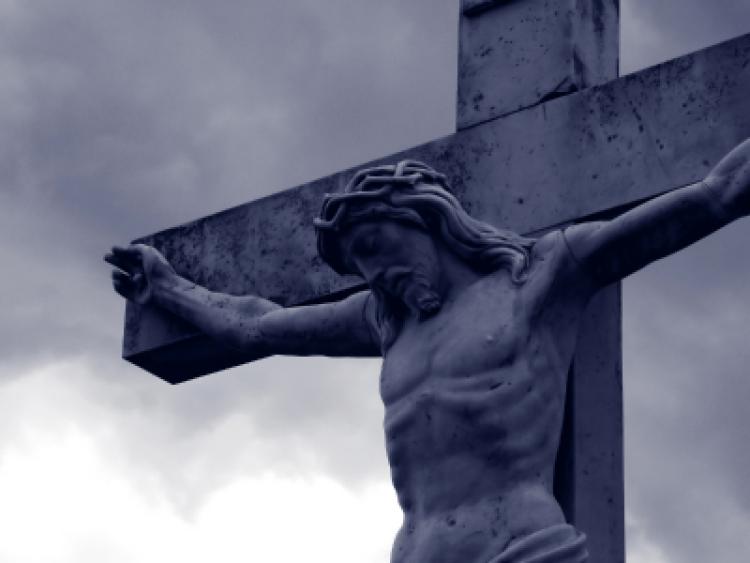
The crucifix, or cross, which represents the way Jesus died, is an important symbol seen on Good Friday. Some crosses bear a figure of Christ. Other symbols of Good Friday include black cloth used to cover the cross, paintings and statues in churches and some homes to signify mourning.
timeanddate.com
Share this:

1991 – The U.S. Supreme Court ruled that jurors could not be barred from serving due to their race.
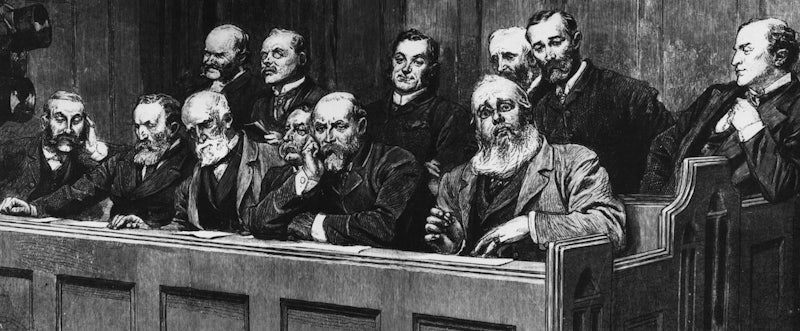
The Supreme Court Takes On the All-White Jury
The high court on Monday will confront a sordid history of juror suppression
By Spencer Amdur
newrepublic.com


You must be logged in to post a comment.