
Monthly Archives: August 2020

“Jim Foley’s Life Stands in Stark Contrast to His Killers”

1993 – NASA lost contact with the Mars Observer spacecraft. The fate of the spacecraft was unknown. The mission cost $980 million
 Aug. 21 proved a remarkably bad day for the nation’s space program. NASA engineers lost all communication with the Mars Observer shortly before the $980 million spacecraft was to begin orbiting the Red Planet. And NOAA-13, a new weather satellite, fell silent as well.
The reason for the sudden silence from the Mars Observer remains a mystery. Glenn Cunningham, project director for Mars Observer at NASA’s Jet Propulsion Laboratory in Pasadena, Calif., says he remains “cautiously optimistic” that the craft has retained a set of critical commands — designed to send it into an elliptical orbit around Mars on Aug. 24 — beamed to the craft the day before communications ceased.
But he and other scientists worry that the commands may have become distorted or erased from the craft’s on-board computer. If so, Mars Observer could not have fired its engines as planned and thus will not go into a low orbit around the planet. The craft simply may have sailed past Mars, ending a two-year mission before it ever began.
If communications should resume by the end of August, engineers could still instruct a wayward Mars Observer to orbit the planet. But calculations show the craft would take 40 days in a highly elliptical path to orbit Mars instead of the 118-minute circular path desired for a detailed study of the planet.
Trouble began about 9 p.m. Eastern Daylight Time on Aug. 21. Technicians had commanded the craft to pressurize its fuel tanks, a procedure that requires the craft to detonate a valve so that helium gas can flow into the tanks. Because the explosion might shock the craft’s transmitters, technicians had deliberately switched them off minutes before, silencing the craft’s only link with Earth. Five minutes later, with pressurization completed, engineers commanded the transmitters to turn on again. The craft remained mute.
Cunningham says there’s “less than a 0.1 percent chance” that the valve detonation –a routine procedure with no more power than a firecracker–might have destroyed the craft. But a NASA contractor who wished to remain anonymous was less confident: “They [JPL officials] are calling it a ‘loss of downlink.’ But you might just as well call it a ‘loss of spacecraft.'” He added that if a leak occurred in the tanks as pressure increased, it could have spun the craft wildly, hurling its solar arrays and other vital parts into space.
Scientists familiar with the Venus-orbiting Magellan spacecraft said that its transmitters — built by a different company than those on the Mars Observer–were not turned off before valve detonations. “That’s just the time [during detonation] when you’d like to have as much communication with the craft as possible,” notes Frank McKinney, project manager for spacecraft mission operations at Martin Marietta Astronautics in Denver.
Cunningham says that if the transmitters had remained on during pressurization, engineers might have gathered more hints about the cause of the communications failure. But he adds that the manufacturer had recommended that NASA turn off the transmitters during such procedures, advice followed previously without problems.
NASA expressed even greater pessimism about the fate of NOAA-13, a new weather satellite intended to replace an aging, but identical model that monitors Earth from a polar orbit. Researchers attribute the loss to a bad battery and don’t expect to recover a signal.
image from NASA of nasamtmountain
Share this:

A Page From Our American Story
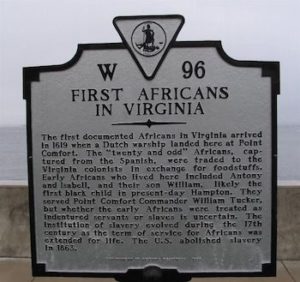 “Pray, what thing in the world can be done worse towards us, than if men should rob or steal us away, and sell us for slaves to strange countries; separating housbands (sic) from their wives and children.” – Germantown meeting
It was on this date in 1619 that 20 Africans arrive at Hampton, Virginia, aboard a Dutch ship. They were the first Africans on record to be forcibly settled as involuntary laborers in the North American British Colonies.
Africans came ashore at Point Comfort, present day Fort Monroe in Hampton, VA. President Barack Obama declared Fort Monroe a National Monument in 2011 in part because he said that is where the first Africans came ashore in North America.
The slave trade began in the mid 1400’s and what we now know as South America. Brazil was the first country in the Americas to benefit from the slave trade initiated by Portugal. Slavery in the west moved up the South American coast through the Caribbean into what became Florida with few records kept before the Dutch cargo docked in Virginia.
Reference:
Black First:
2,000 years of extraordinary achievement
by Jessie Carney Smith
Copyright 1994 Visible Ink Press, Detroit, MI
ISBN 0-8103-9490-1
– National Museum of African American History and Culture
— from The Germantown Protest (against slavery).
image from AAREG.org
project1619
Board of Directors
We are a Grassroots organization whose members have been working for 25 years to get America and the World to know the true history about the arrival of the first Africans to land in Colonial America at Point Comfort, today’s Fort Monroe in Hampton, Virginia, in August 1619.
Board Members
Calvin Pearson, President
Audrey Williams, Secretary
Dr. William Wiggins, History and Educational Director
Gary Kelly
Larry Gibson
Margaret Bristow
Melinda Steele
Rivers Taylor
Jannie Evans
Past Board Members
Willis Evans – deceased
Hugh Harrell III – deceased
National Advisory Board Members
Venita Benitez, Founder, National Freedom Day, Dallas, Texas
Prof. Robert Watson, Professor, Hampton University
Kathryn Knight, Book Author, Historian, Genealogist, Florida
Mr. Andrew Williams, Jr., President, Five Point Foundation Inc., Los Angeles, California
Affiliated Organizations
Weyanoke Red Black
National Juneteenth Observance Foundation
Hampton Contraband Historical Society
The City of Hampton
ASALH
National Freedom Day
Kinfolkdetective.com AAHGS




You must be logged in to post a comment.